
Malaysia's 8-Month Government Speech Therapy Waitlist: What Happens While You Wait
Updated: Aug 3
You called the hospital. You explained your concerns — clearly, carefully, with all the specific things you had been noticing for months. And then you were told: "The next available appointment is six to eight months away."
Six to eight months.
If that number landed like a door closing, you are not alone. Parents across KL and Petaling Jaya describe exactly this moment — and the quiet dread that follows. Because six to eight months is not abstract. It is your child's third year. Or their fourth. Or the last stretch before Standard 1.
This article explains why the waitlist is what it is, what is actually happening to your child's development during that time, and what your options look like — both within the government system and alongside it. For a broader look at what your child should be developing across all areas at this age, the Early Minds guide to child development in Malaysia (ages 3–10) is a useful companion.
Why the Government Speech Therapy Waitlist Is So Long
Malaysia's public healthcare system provides subsidised and often free speech therapy — and that is genuinely valuable. The challenge is that demand has grown far ahead of capacity.
A single speech therapist at a public hospital in the Klang Valley may carry a caseload of hundreds of children at any given time. Government hospitals and district clinics across the Klang Valley are doing their best within a system under strain. This is not a failure of any individual clinician. It is a structural problem: the ratio of trained speech therapists to the number of Malaysian children who need support is simply too low.
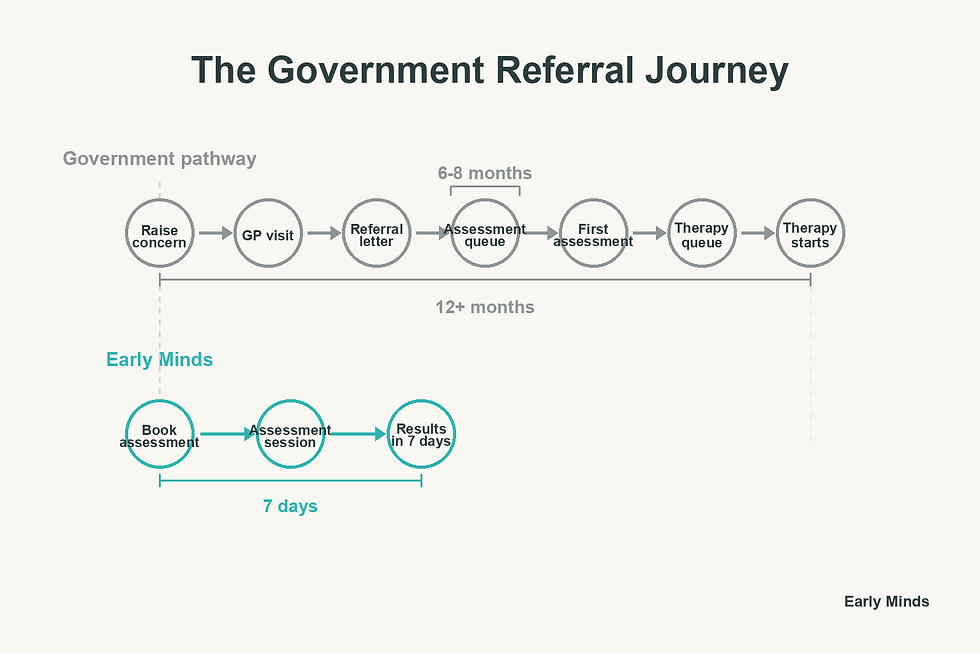
The referral process adds further delay. To access government speech therapy, a child typically needs a referral from a GP or paediatrician first, then an assessment appointment, and then placement on the therapy waitlist. Each step is its own queue. In many public hospitals, parents in KL and Petaling Jaya commonly report waiting six to twelve months — sometimes longer — from the time they raise concerns with their GP to the time their child begins therapy.
The therapists in these hospitals are doing meaningful work under difficult conditions. The system is under strain, not broken — and for families who need long-term, subsidised support, it is still a valuable option.
What Actually Happens to Your Child's Development During a 6-to-8-Month Wait
This is the part worth sitting with.
The early years — particularly ages three to seven — are the period of the highest neuroplasticity the brain will ever experience. The connections that support language, communication, and social understanding are forming at a rate that will not be repeated later in life. A child who is waiting six to eight months for assessment is not simply pausing at their current level. They are continuing to develop — just without targeted support for the areas where they are struggling.
Language development is compounding in nature. Words build sentences. Sentences build reading. Reading builds school confidence and social participation. A child who does not have functional words at three has less scaffolding for sentences at four, less scaffolding for pre-literacy at five. The gap between them and their peers does not stay the same — it tends to widen.
Parents in Malaysian parenting forums describe this feeling with painful clarity: "Told it was just a speech delay; now I feel I've lost the most precious year for my child's progress." That is not an exaggeration. It is what the research on early language intervention consistently shows — the earlier the support, the faster and more complete the progress.
For children approaching Standard 1, the stakes are especially visible. Primary school entry marks a shift from play-based to language-heavy learning almost overnight. Children who start that transition without adequate communication skills face a steeper climb — socially and academically.
None of this is meant to alarm you. Many children catch up beautifully with the right support. The point is simply that "the window" — the period when intervention is fastest and most effective — is not infinite. And it is open right now.
How long is the speech therapy waitlist in Malaysia?
The government speech therapy waitlist in Malaysia averages six to eight months, depending on which hospital or Klinik Kesihatan you are referred to and your location. Some parents in KL and Petaling Jaya report waiting up to twelve months for a first assessment appointment at a government hospital, particularly at high-demand urban facilities.
It is worth noting that this wait is for the first assessment — therapy itself typically begins weeks or months after that, depending on the child's assessment outcome and how the caseload is managed at that facility. The practical reality for many families is that the journey from "I have a concern" to "my child starts therapy" can stretch well beyond the initial eight-month figure. Waitlist length also varies: parents in smaller towns often report shorter waits than those in central KL.
Your Options While You Wait (or Instead of Waiting)
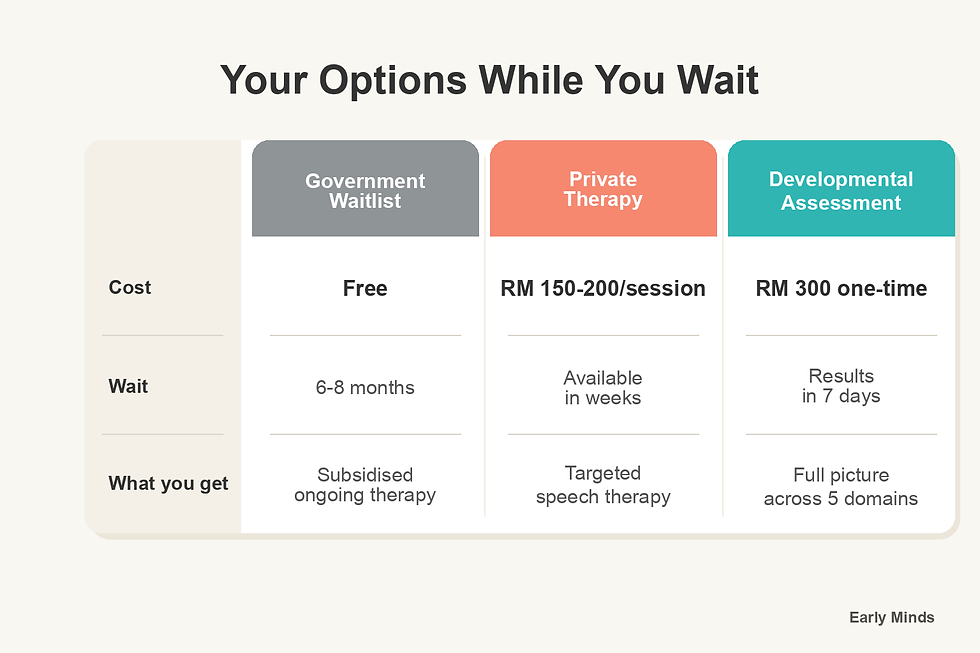
There is no single right answer here. The options below are honest, not prescriptive.
1. Stay on the government waitlist and supplement at home
Being on the government waitlist does not prevent you from pursuing private support — and getting your name on the list now means you have that slot in six to eight months, even if other things happen in between. While you wait, daily language-rich routines make a real difference: naming objects, narrating activities, asking open questions, and allowing time for your child to respond. The limitation of home strategies is that without knowing exactly where your child's gaps are, you are working broadly rather than precisely.
2. Private speech therapy (RM 150–200 per session)
Private speech therapists in KL and PJ are generally available within days or weeks, not months. Private speech therapy centres and independent clinics operate across the Klang Valley. The barrier is cost. At RM 150 to RM 200 per session, and a recommended frequency of once or twice weekly, monthly costs can reach RM 600 to RM 1,600. "Private therapy feels like a second mortgage" is how one Malaysian parent put it on Reddit — and for many middle-class families, that is genuinely true. If you are weighing the cost question, our article Is a developmental assessment worth RM 300? walks through how to think about value and what different options actually deliver.
3. Start with a developmental assessment
Before committing to ongoing private therapy, a one-time comprehensive developmental assessment gives you a precise picture of where your child stands — which areas need support, which are on track, and what specific interventions are most likely to help. This prevents the frustration of spending on the wrong type of therapy, at the wrong frequency, for the wrong reasons. Think of it as a map before a journey.
Frequently Asked Questions
Can I be on the government waitlist and use private therapy at the same time?
Yes. Being on a government hospital waitlist does not prevent you from seeking private speech therapy or a private developmental assessment. Many Malaysian families do both — keeping the government slot for subsidised ongoing therapy while starting earlier with private services. You do not have to choose one path or the other. That said, once your child starts therapy, it is better to stay with one therapist's plan rather than mixing approaches. Getting the referral and the government slot costs nothing to maintain.
What is the difference between a speech therapy assessment and a developmental assessment?
A speech therapy assessment focuses specifically on your child's communication — articulation, language comprehension, and expressive language. A developmental assessment is broader: it looks at speech alongside motor skills, social development, sensory processing, and cognitive ability together. If you are unsure where your child's difficulties are centred, a developmental assessment gives you the complete picture first, before you invest in a specific type of therapy.
At what age should I seek a speech therapy assessment in Malaysia?
If you have concerns, do not wait for a specific age to act. Concerns at age two to three should be raised with your paediatrician. Most developmental specialists recommend assessment before age five where possible — the evidence base for early intervention is strongest during the preschool years. If your child is older, assessment is still very worthwhile. Understanding exactly what to work on is valuable at any age.
What You Can Do Right Now
Three practical steps, regardless of which path you choose:
Get the referral letter now. Ask your GP or paediatrician for a referral to your nearest government hospital speech therapy unit. Getting on the list today means you have that option available in six to eight months — even while you pursue other steps in the meantime.
Start language-rich routines at home. Name objects during meals, bath time, and the drive to school. Narrate what you are doing. Ask questions and wait for a response, even if it does not come yet. These habits build language scaffolding for any child at any developmental stage.
Get a clear picture before choosing a therapy path. A one-time developmental assessment tells you exactly which skills your child needs support in — so that any private therapy you invest in is targeted rather than generic.
If you have been told to wait, here is what you can do now.
The Early Minds Developmental Assessment (RM 300, one session) is designed for children aged 3 to 10. It covers speech and language alongside motor skills, sensory processing, social development, and cognitive ability — all five domains in a single session. Results are delivered to you within seven days, not six to eight months, with a clear explanation of where your child stands and specific recommendations to guide any next steps, including whether private speech therapy is warranted, what type, and at what frequency. A written report is available as an optional add-on.
Parents who come in consistently tell us the same thing: the hardest part was making the first call. Everything after that was straightforward.
If private speech therapy is on your list and you are unsure whether a developmental assessment is the right first step, see Is a developmental assessment worth RM 300? for a full cost and value breakdown.
About the Author
Written by Kee Joey, Clinical Psychologist, Early Minds. Kee Joey specialises in developmental assessment and early intervention for children aged 3–10 through the Early Minds programme at Ripple Community, Petaling Jaya.

Comments