
5 Signs of Developmental Delay in Children: What Malaysian Parents Should Know
Updated: Aug 3
Your three-year-old still isn't putting two words together. Your mother says boys talk late. Your sister says her son was the same and turned out fine. But something in you says this feels different.
That instinct matters. Acting early, between ages 3 and 5, makes a real difference to outcomes.
Before diving into the signs, if you want a broader picture of what typical development looks like at each age, start with our Child Development Malaysia: Parent's Guide (Ages 3–10) — it covers milestones across speech, social, motor, and cognitive domains in one place.
Why These Signs Are So Easy to Miss
Developmental delays in the 3–5 age range often look like normal variation — shyness, strong will, being the youngest sibling, or simply "being a boy." In Malaysia, the "wait and see" advice usually comes from people who love your child. That's not blame; it's the reality that most people around us aren't trained to spot the difference between a phase and a pattern. That's exactly what a developmental therapist is trained to do — observe across time, across settings, and across domains.
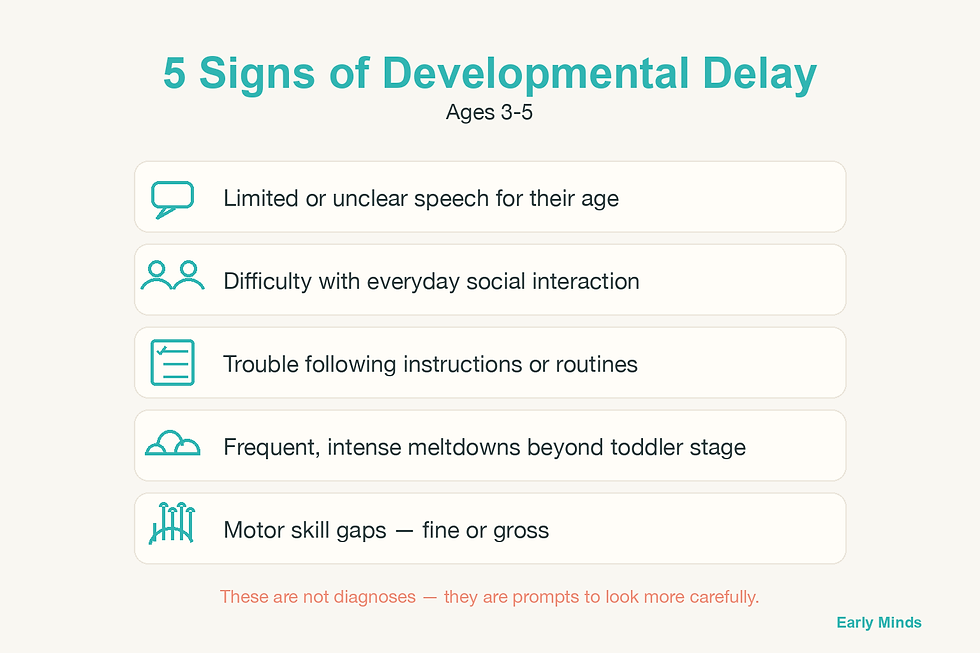
5 Signs of Developmental Delay in Children Aged 3 to 5
The following signs are not a diagnostic checklist. They are the kinds of patterns therapists look for when a parent says something feels off. Each one can have a range of explanations. The goal is not to alarm — it's to help you name what you're seeing clearly enough to take the next step.
Limited or unclear speech for their age By age 3, most children are forming short sentences of two to three words and can be understood by people outside the family. By ages 4 to 5, they are typically telling simple stories, asking lots of questions, and holding short conversations. A child who is still mostly pointing, using single words, or whose speech is only understood by a parent may be showing more than a late-talking pattern. Therapists look at not just the number of words, but whether the child uses language to communicate needs, respond to questions, and connect with others. Note: bilingual households — English and Bahasa Malaysia — are common in KL/PJ, and research suggests bilingualism does not cause delays, though it can make the picture more complex.
Difficulty with everyday social interaction Avoiding eye contact during play, not pointing to share something interesting ("look, a butterfly!"), preferring to play alongside rather than with other children, or struggling to read facial expressions — these are worth noting. This is not about being "unfriendly." Shyness is a personality trait; difficulty with the back-and-forth mechanics of social engagement is something different. Therapists look at whether a child wants to connect but struggles to, versus a deeper pattern of disinterest in shared experience.
Trouble following instructions or routines A 3-year-old should typically manage a simple two-step instruction ("pick up your shoes and put them by the door"). By ages 4 to 5, most children can follow a three-step sequence. Persistent difficulty — not the occasional ignoring that is entirely normal — may indicate differences in how a child processes and sequences information. Many Malaysian parents hear "he's just stubborn." The distinction worth making: a child who ignores instructions is behaving; a child who genuinely cannot process and carry them out is experiencing something developmental. They look similar from across the room.
Frequent and intense meltdowns beyond the typical toddler stage By ages 4 to 5, most children have developed some capacity to regulate their emotions with adult support — not perfectly, but noticeably. Meltdowns that remain very frequent, very intense, or that are triggered by things that seem minor (changes in routine, certain textures, sounds, transitions between activities) may point to sensory processing or emotional regulation differences. This is one of the hardest signs to talk about. Many parents describe dreading outings because they never know what will trigger a meltdown — and the side-eyes from strangers, the quiet judgment, makes an already exhausting moment worse. If that sounds familiar, you are not a bad parent. You are a parent who is paying attention.
Motor skill gaps — fine or gross By ages 4 to 5, a child should typically be able to draw a rough circle, hold a crayon with some control, use scissors with assistance, climb stairs with alternating feet, and run and jump without frequent falls. Difficulty with tasks like doing up buttons, catching a ball, or managing a pencil is sometimes the last thing parents notice — because it's easy to attribute to a child being "not sporty" or "not artistic." It's also worth noting that motor development is closely connected to school readiness. For parents in KL/PJ preparing for Standard 1 entry, these are the kinds of skills teachers will expect. If you want to know what therapists actually check during a formal assessment, this guide to developmental assessments in Malaysia walks through the process step by step.
What These Signs Do Not Mean
Recognising one or two of these signs does not mean a diagnosis is coming. It means it's worth getting a clearer picture. These signs are a reason to find out — not a verdict. Children develop at different rates, and an assessment does not label a child. It shows where they are right now, what is going well, and what kind of support would help them get where they are going. Think of it as a tool for you as a parent, not for the system.
Frequently Asked Questions
At what age should I be concerned about developmental delays in Malaysia?
Most developmental red flags in the 3–5 range are worth noting from age 3 onwards. If a child is not using two-word phrases by age 2, or is not combining three to four words into short sentences by age 3, those are the points at which developmental therapists typically recommend a formal assessment. The research is consistent: early action between ages 3 and 5 gives children the widest window for intervention.
Is it normal for Malaysian children to develop more slowly because they are learning two languages?
Bilingualism does not cause developmental delays. Children learning English and Bahasa Malaysia simultaneously may have different patterns of word distribution across both languages, but the total number of words across both should still follow typical developmental milestones. If there are concerns, a developmental assessment can account for the bilingual context — a good assessor will look at the full picture, not just one language.
What is the difference between a developmental delay and autism?
Developmental delays refer to a child progressing more slowly than expected in one or more areas — speech, motor, social, or cognitive. Autism is a specific neurodevelopmental condition involving consistent differences in social communication, sensory processing, and behaviour. Some children with autism also have developmental delays; many children with developmental delays do not have autism. A developmental assessment clarifies what is actually going on, rather than leaving a family to rely on Google and guesswork.
How long does a developmental assessment take in Malaysia, and how much does it cost?
Government hospital assessments in Malaysia can involve waitlists of up to 8 months — and in some cases longer. The Early Minds Comprehensive Developmental Assessment is RM 300, and results are delivered within 7 days. The assessment covers language, motor, social, cognitive, and behavioural domains in a single session, giving you a complete picture across all five areas rather than a piecemeal view.
What You Can Do Right Now
Observe and note — don't Google and spiral. Spend a week watching your child with fresh eyes. Write down specific examples of what you are seeing: dates, situations, what happened. Not to diagnose — but to have something concrete to share with a professional. "He seems behind" is hard to work with; "He couldn't follow a three-step instruction on Tuesday even after two repeats" is useful.
Talk to your child's preschool or taska teacher. Ask specifically what they observe during structured activities, unstructured play, and group time. Teachers often see things at school that parents don't see at home — and their observations carry real weight in any formal assessment.
Trust the instinct that brought you here. The parents who make the most difference for their children are not the ones who acted perfectly or caught everything early. They are the ones who trusted their own observation over the pressure to wait. You noticed something. That matters.
The Early Minds Assessment: Clarity in 7 Days
If you have read through these signs and found yourself nodding at more than one of them, you are probably wondering what to do next.
The Early Minds Comprehensive Developmental Assessment is not about labelling your child. It is about getting a clear, professional picture: what is going well, where support would help, and what that support looks like in practice. Instead of waiting months for a government assessment slot, Early Minds delivers results within 7 days. The session covers all five developmental domains — language, motor, social, cognitive, and behaviour — and the results walkthrough is included.
One of the things parents describe most after going through the process is relief. Not because everything was fine, but because they finally knew exactly what was happening and what to do about it. That clarity is the point.
Written by Kee Joey, Clinical Psychologist, Early Minds.
This article is intended for informational purposes only and does not constitute a clinical assessment or diagnosis. If you have concerns about your child's development, please consult a qualified developmental professional.

Comments